Simplicity is probably the most important underlying factor when it comes to the performance of any Web page... whether your homepage, an interior page, a sales page, or a landing page.
Here are six ways to keep your pages simple and increase conversions.
1. Stick to one topic per page
This may not be possible always. But if you can stick to just a single topic, product, or service per page, then you simplify the experience for your visitors.
They don't have to choose—they don't have to decide where to focus their attention. All they have to do is read. From top to bottom.
2. Minimize the number of columns
Multi-column pages complicate the experience for your readers. Different areas of the page are competing for their attention. Again, they have to make choices, they have decide which column to look at first.
Or worse still, they may be reading your center information or sales column and then stop reading because they are distracted by something in another column.
If you can build your page with one column only, that is optimal and almost always has a significant impact on conversion rates.
3. Keep your message simple
As you write, try to stay focused on a single, simple message. Too many times copywriters bring in all kinds of "related" information into their sales copy.
If it is tightly related, that's fine. But when it is not directly relevant to the one topic and one purpose of your page, it can be distracting.
Keep your writing focused, linear, and progressive.
4. Don't use too many graphics
One or two graphics can help support your sales message. Some products or service can benefit from the use of a couple of well-placed graphics, but others don't need them at all.
Whatever you do, don't add too many images and graphics to the page. Again, they can fragment the reader's eye path. They distract attention from the sales message. And often for no good purpose.
5. Keep your offer simple
If you are writing a sales page, whether you are selling a subscription or a product, it is tempting to offer a number of purchase options. "If they don't want an annual subscription, maybe they'll go for a monthly subscription." Or, "If they don't want this product, maybe they'll want this one."
However, repeated testing has shown that providing multiple choices reduces conversion rates. Too many choices result in uncertainty and inaction.
Do some testing to determine the most profitable offer... and stick with that one.
6. Make your subscription or sales forms simple
The longer the form, the lower the conversion rate. It's as simple as that. So ask only for the information that is essential to complete the desired action. If you would like to collect additional information from your subscriber or purchaser, ask on the confirmation page, or with a follow-up email.
Final thoughts...
Someone within your company or development group will always come up with good reasons for adding elements to a page—whether words or graphics—that are not central to the topic or message.
Resist them if you can.
Simplicity in every aspect of your site, on every page, will increase your conversions and revenues.
Source: http://www.marketingprofs.com/6/usborne30.asp

Tuesday, October 10, 2006

Wednesday, September 27, 2006
Bad Things Happen to Brands When Companies Run out of Ideas
Article Extracted from http://www.marketingprofs.com/6/asacker6.asp
But here's the paradox: Wal-Mart's brand value increases when those products stay the same—when consumer goods companies run out of ideas.
Tom Asacker
September 26, 2006
But here's the paradox: Wal-Mart's brand value increases when those products stay the same—when consumer goods companies run out of ideas.
To understand why is to understand the nature of marketplace choice in today's hourglass economy: "Almost every category of consumer goods is in the process of forming into pools at both ends of the market," writes author Michael J. Silverstein in his new book, Treasure Hunt: Inside the Mind of the New Consumer. "In category after category, premium entries are growing, bargain brands are stealing share, and the middle is shrinking. "
Or to place his observation into marketing context: brands that innovate are growing, and brands that don't innovate are transferring their equity—and subsequent long-term income growth—to low-cost manufacturers and discount retailers.
In fact, Wal-Mart built one of the world's most valuable brands off of the backs of the world's most well-known brands. By pressuring manufacturers to reduce prices year after year on products that, in essence, don't change, Wal-Mart created a consumer expectation of one-stop shopping for trusted, bargain brands. Hence, the trusted—and growing—Wal-Mart brand: "Everyday low prices" on stuff that's perceived as "good enough."
But that's just half of the hourglass. The top half is growing as well, with distinctive products that offer tangible and emotional value for which people are willing to pay a premium. The one place a company doesn't want to find itself is stuck in the shrinking middle.
This shrinking middle is where many of America's most well-known and well-respected brands find themselves today—from iconic fashion brands like Levi Strauss, to Sara Lee's tired food and apparel brands, to Kraft Foods' household cheese brands.
And their self-imposed positions were fairly simple to foretell; all you had to do was watch their marketing efforts. When I discovered a $20 pair of Levi's jeans at Wal-Mart, the company's destiny was clear. I also watched Sara Lee's brands suffer from a paucity of innovation and gratuitous price reductions. And it appears from behemoth Kraft's recent predatory pricing practices on various supermarket cheese brands that it too has run out of ideas and is on the brink of handing over its well-deserved equity.
At face value, these tactics may appear to be temporary marketing maneuvers designed to reduce the encroachment of competitive brands, including store brands, and thus increase market share. In fact, they are conspicuous announcements by Levi Strauss, Sara Lee, Kraft, and others that "our brands are really nothing special" and therefore smart shoppers should choose based on price.
And once customers have relegated a brand to commodity status, to a choice made on price alone, it is very difficult—and expensive—to get them to trade back up for that brand in the future. So what's a consumer products company to do?
America's top consumer brands are at a crossroads and have some tough decisions to make to avoid being caught in this fatal squeeze of increasing sales and shrinking profits: Should we satisfy the street today or wow our customers and satisfy the street over time? Do we create real brand value or trade our equity to "hit the numbers?"
The two long-term strategic options are glaringly clear: re-engineer the business to become the world's low-cost producer, or invest in new product development and value-added marketing. The surer path to profitable market share growth is the latter, since it has been proven that customers will pay more if they feel that they are receiving additional value with the higher price.
So while struggling Levi's obsession with volume informs it schizophrenic product offering, fashion-obsessed Polo Ralph Lauren buys back its Polo Jeans license from Jones Apparel Group to stay focused on differentiated, high-end products. As Sara Lee attempts to boost sales of its Jimmy Dean sausage brand with quirky TV advertising, Nestle, the world's biggest food company, invests in patented technologies to tackle obesity and diabetes. And while Kraft surrenders to commodity pressures with price reductions, family-owned Sargento innovates with Bistro Blends, a proprietary idea mixing premium cheeses with herbs and spices.
Make no mistake about it: When companies run out of ideas, bad things happen to brands. Instead of differentiating their offerings with meaningful value-added features, like healthier and more flavorful products, time-saving recipes and packaging, or even emotive, associative value, marketers end up resorting to price cuts and special promotions. Instead of taking a long-term view of customer value and growth in sales, earnings and new product development, their focus shifts to a short-term desire to grow market share with discounting and deal-making.
Yes, there is a subsequent growth in revenue, but brand equity is damaged and profit margins invariably get chewed up as once-loyal customers migrate to even less-expensive commodity brands. And as with many fashionable new trappings, it's a position that is easy to slip into but can become a real struggle to wiggle out of over time.
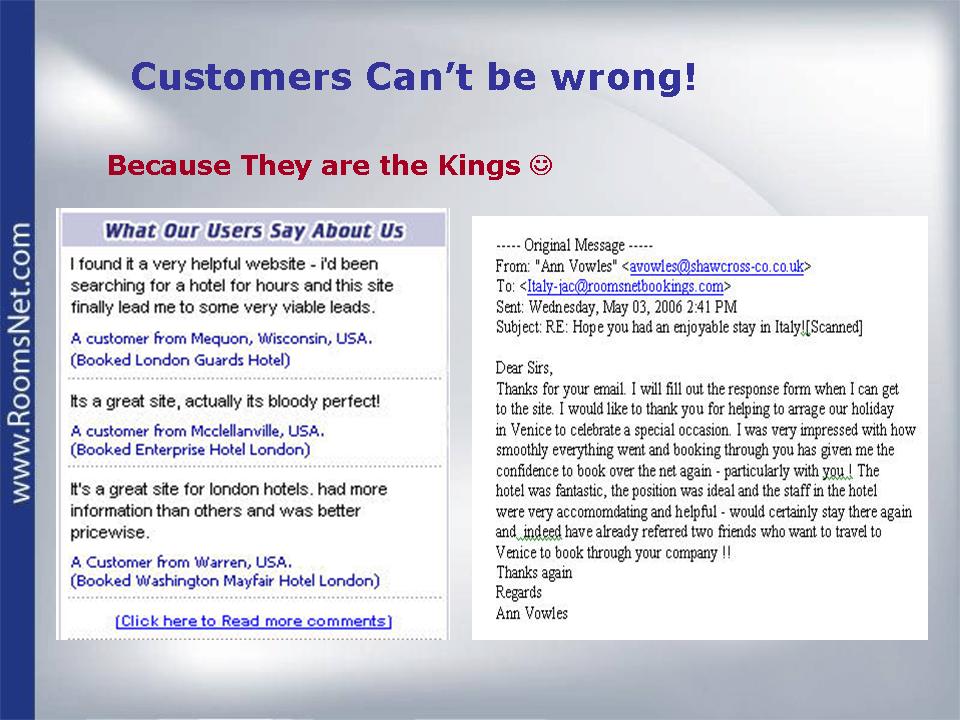
Managing Destinations at RoomsNet
Presentation Done by Amitha Amarasinghe, Nuwan Ireshini & Upeksha Premthilake.






Thursday, August 31, 2006
Redefine your marketing mix with eCommerce & eMarketing
Presentation done by Suranga Priyashantha at the first Jamagra symposium


Subscribe to:
Posts (Atom)